|
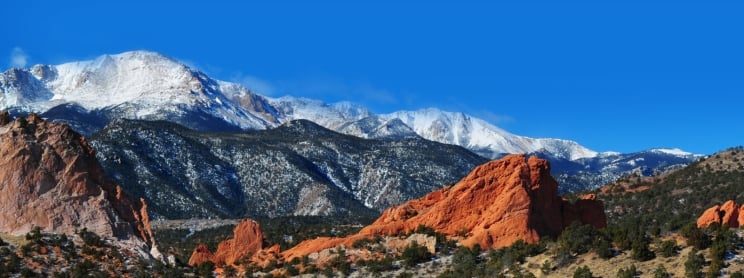
Classic view of Pikes Peak from Garden
of the Gods
Pikes Peak is named for Zebulon Pike, an
early explorer of the Southwest. Lieutenant (later General) Pike first sighted what he
termed the "Great Peak" in mid-November of 1806. A few days later, he attempted
to climb it with a small band of men. Heavy snows in the 10,000 foot area turned his party
back. He estimated the mountain's height at over 18,000 feet (he was only 4000 feet off!)
and is said to have claimed that it might never be climbed. However, a botanist who
climbed many peaks in Colorado, Edwin James, did ascend the
mountain in 1820. By the mid-1800's, a trail was well established to the top, and
the first woman, Julia Holmes, climbed the peak in 1858.
However, long before Pike explored the area, the Ute
Indians paused at the foot of the mountain as they traveled from their summer
campgrounds to the winter hunting grounds. Most likely, they scaled Pikes Peak
to place eagle traps on its summit, a common practice used on high peaks in order to
obtain ceremonial feathers. The Spanish were well aware of the mountain through numerous
expeditions, especially that of Juan De Anza, who explored the region in 1779.
Trappers had also been working the territory which was rich with beaver, deer, elk, bear,
buffalo, bighorn sheep and mountain lions around the same time.
Pike's Peak proximity to the edge of the Great Plains and its
height made it the
first sight of wagon trains searching for new fortunes
and beginnings in the American West, leading to the
expression in the late 1850's of "Pikes Peak or Bust".

Pikes Peak from High
Point in Garden of the Gods Park
(taken May 8, 2007)
Due to its natural beauty, the Pikes Peak region has always been a magnet for
travelers. The first person to promote the area widely was General Palmer, founder of the
Denver and Rio Grande Railroad.

Balanced Rock in Garden of the Gods Park
He was so enthralled with the attraction of the area that
he made his home here. He also realized that the scenery of the region could help promote
rail travel to the area -on the D&RG RR .
Pikes Peak quickly became
popular, and many people over the years found ways to travel to its summit. The U.S.
Signal Service (an early Weather Bureau) built a telegraph station on the summit in 1873
to monitor the weather, and a guard was posted in Manitou at the beginning of the trail to
collect a toll for hiking to the summit. On May 25, 1876, an interesting
hoax was perpetrated by one of the soldiers and his wife who lived at the summit house
when they claimed that their baby daughter had been eaten by giant rats! (Sgt.
John O'Keefe had a vivid imagination- earlier he had claimed that Pikes Peak was erupting.)

Plaque says" Erected in memory of Erin O'Keefe-
Daughter of John and Nora O'Keefe
who was eaten by Mountain Rats in the year 1876"
Photo courtesy Tom Jamison & Family
The founder of the Manitou & Pikes Peak Cog Railway was a
Mr. Zalmon Simmons, owner of the Simmons Mattress Company and also quite an
inventor. Mr. Simmons had patented a new insulator for the telegraph wires which were in
use up to the signal station. In the late 1880's, Mr. Simmons rode a mule to the
top of Pikes Peak to inspect his creations. He was awed by the incredible views,
but was worn out and saddle-weary by the arduous trip. Legend has it that as he sat
soaking in one of the mineral spring spas (reportedly at the Cliff House in Manitou), the
proprietor of the hotel mentioned to him the idea of a mountain railroad to the summit.
Mr. Simmons was taken with the idea, and soon set about organizing a company to build this
scenic railroad. You can read more about the
History of the Pikes Peak Railway here.
In 1889, a carriage road was opened from Cascade, Colorado
to the top. Horses brought passengers about half way, and then mules (noted for their
hardiness at altitude) finished the journey. The opening of the Cog Railway, however,
forced the carriage road into disuse until 1915, when Spencer Penrose, local
entrepreneur and builder of the Broadmoor Hotel, enlarged and improved the roadbed for
automobile travel. To promote his highway around the world, he began in 1917 the
"Pikes Peak Hill Climb", the second oldest auto race in America. Mr. Penrose
eventually purchased the Cog Railway in the 1920's, reportedly to obtain the parking and
summit house for auto travelers on the highway.
Another local entrepreneur decided that the back of a burro was
the best way to see the Peak (as opposed to Mr. Simmons), and from 1914 until
1917, Fred Barr built the trail that now bears his name. Mr. Barr operated a
burro concession from the upper terminal of the now-defunct Mount Manitou Incline Railway.
Hearty souls would ride to a group of cabins (Barr Camp) and spend the night there. Early
the next morning, they would ride the burros to the summit and return back to Manitou. The
trail was later extended to reach all the way back to Manitou Springs. Strong hikers today
can make the 13 mile trip along the beautiful, but very steep, Barr Trail.
About halfway along the way is
Barr Camp, where
intrepid hikers can get a meal or a bunk for the night (reservations are usually needed)..
Pikes Peak from Crystal Reservoir
Three Interesting Tidbits:
1. Pikes Peak IS NOT the highest mountain in Colorado.
It is 31st out of the 54 mountains in the state over 14,000 feet, the highest being Mt.
Elbert at 14,433 feet.
2. We owe the inspiration for the lyrics of the beloved song, "America
the Beautiful " to the stunning vistas from the summit of Pikes
Peak. It was the summer of 1893, and Katharine Lee Bates, a
professor of English at Wellesley College, was in Colorado Springs to teach a summer
session at Colorado College. On July 22, Katharine, along with several others of the
visiting faculty, took a trip in a carriage to the summit of Pikes Peak. Horses got them
to the halfway point, and, as was customary, a team of mules finished the climb to the
14,115 foot summit. Because altitude sickness affected of one of the party, they only stayed on
the summit a half hour, but the brief experience was enough inspire a poem. She
wrote.. "An erect, decorous group, we stood at last on that Gate-of-Heaven
summit...and gazed in wordless rapture over the far expanse of mountain ranges and
sea like
sweep of plain. Then and there the opening lines of 'America the Beautiful' sprang
into being." ..... "I wrote the entire song on my return that evening
to Colorado Springs."
3. When traveling up Pikes Peak (or any mountain) ascending
1000 feet is like traveling 600 miles to the north. The temperature drops about
3.5 degrees, and different life zones are experienced. So, in general, the top of
the Peak is 30 degrees colder than at the station in Manitou.
See: Current Weather
Plant and animal life is extensive and varied on Pikes
Peak. The mountain encompasses four of the eight distinct life zones that exist in
Colorado.
Before
you reach the Railway, you are in the Eastern Plains Zone (up to 6,000
feet) which is comprised of wildflowers and grassland and is home to many small
animals like prairie dogs and rabbits.
The
depot is located at 6,571 feet. The Foothills Zone (6,000 to 8,000 feet)
is composed of small bushes and trees such as scrub oak, juniper, sagebrush
and pinion pine and is inhabited by raccoons, skunks,
various squirrels, deer and an occasional bear and mountain lion.
The Montane Zone (8,000 to 10,000 feet)
has various wildflowers and small shrubs, but large forests of pines and Douglas
fir, as well as the colorful aspen tree, are predominant. Deer,
elk, bear and mountain lions can all be found at this attitude.
The Subalpine Zone (10,000 to 11,500
feet) is less hospitable. Englemann spruce, Douglas fir and bristlecone pine comprise
the areas dense forests. It is estimated that some bristlecone pine trees on
Pikes Peak are over 2000 years old. (There is an excellent internet site
on these trees and their age..it's at this link http://www.sonic.net/bristlecone/home.html)..
In the Alpine Zone (11,500 feet and
above), tundra composed of tiny flowers, mosses and lichen eke out a cold
existence in the short growing season.

The denizens of this windy zone are mainly the yellow-bellied
marmot and the bighorn sheep. The marmot hibernates during the winter, but the
sheep migrate to lower and more hospitable regions.

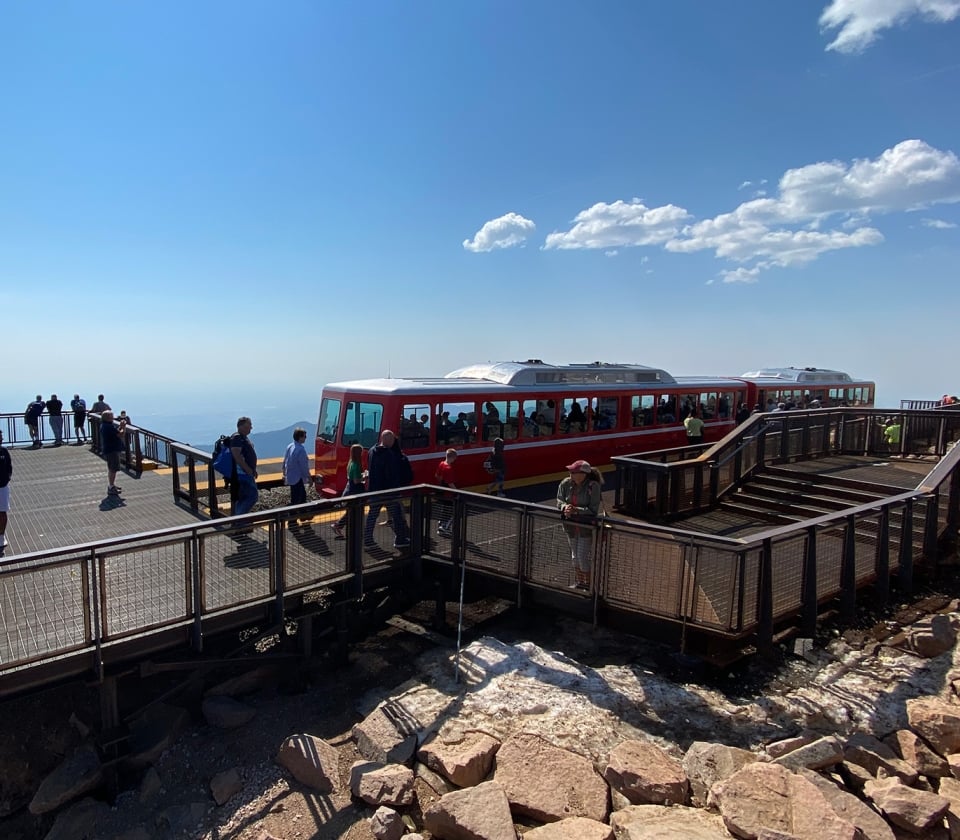
Pikes Peak is home to one of
Colorados largest bighorn sheep herds, and riders on the Cog Railway
frequently see many of these magnificent animals.

Cog Ry Home /
Along
the Route /
History /
About
Pikes Peak /
Rates-Reservations /
Gift Shop /
Special Events
/ SNOW / Swiss Trains /
Rail-Colorado
Links /
Employment /
What's
a Cog? /
Lodging /
DIRECTIONS
/
Maintenance / Coupon
|